Multiple Choice
Identify the
letter of the choice that best completes the statement or answers the question.
|
|
|
1.
|
Who did
delegates unanimously agree should preside over the Constitutional Convention? a. | Benjamin
Franklin | c. | John
Adams | b. | Thomas Jefferson | d. | George Washington | | | | |
|
|
|
2.
|
Although
elected as a delegate, ____ opposed the Constitutional Convention and did not
attend. a. | Thomas
Jefferson | c. | John
Hancock | b. | Patrick Henry | d. | Charles Pinckney | | | | |
|
|
|
3.
|
The ____
called for Congress to have a Senate and a House of Representatives. a. | Virginia
Plan | c. | Great
Compromise | b. | Three-Fifths Compromise | d. | New Jersey Plan | | | | |
|
|
|
4.
|
What plan
proposed that every five enslaved persons would count as three free persons? a. | the Three-Fifths
Compromise | c. | the New Jersey
Plan | b. | the Cotton
Compromise | d. | the Five-Thirds
Plan | | | | |
|
|
|
5.
|
The form of
government in which power is divided between the national government and the states is
called a. | federalism. | c. | anarcho-syndicalism. | b. | nationalism. | d. | anti-federalism. | | | | |
|
|
|
6.
|
Which part
of the Constitution states the six purposes of the government? a. | Preamble | c. | amendments | b. | articles | d. | Bill of Rights | | | | |
|
|
|
7.
|
The powers
and duties of the ____ include dealing with the leaders of other countries. a. | legislative
branch | c. | industrial
branch | b. | judicial branch | d. | executive branch | | | | |
|
|
|
8.
|
The
necessary and proper clause, also called the Elastic Clause, allows Congress to exercise what type of
powers? a. | wartime
powers. | c. | unconstitutional
powers. | b. | implied powers. | d. | judicial powers. | | | | |
|
|
|
9.
|
According to
which principle of democracy, the law applies to everyone, even those who govern? a. | rule of
law | c. | Bill of
Rights | b. | Third Amendment | d. | First Amendment | | | | |
|
|
|
10.
|
What refers
to powers given to state governments but not to the national government? a. | expressed
powers | c. | separation of
powers | b. | checks and balances | d. | reserved powers | | | | |
|
|
|
11.
|
____ was a
famous diplomat, writer, inventor, and scientist who attended the Constitutional
Convention. a. | George
Washington | c. | Patrick
Henry | b. | Benjamin Franklin | d. | John Adams | | | | |
|
|
|
12.
|
A committee
headed by Roger Sherman of Connecticut developed which proposal? a. | Three-Fifths
Compromise. | c. | Great
Compromise. | b. | Virginia Plan. | d. | New Jersey Plan. | | | | |
|
|
|
13.
|
What is the
group of people named by each state legislature to select the president and vice
president? a. | the
Senate | c. | the House of
Representatives | b. | the Electoral College | d. | the Federalists | | | | |
|
|
|
14.
|
The ____
believed the Constitution should provide protection for certain basic liberties. a. | Anti-Federalists | c. | Whigs | b. | Liberals | d. | Abolitionists | | | | |
|
|
|
15.
|
What part of
the Constitution deals with how the legislative branch will work? a. | Preamble | c. | Article
I | b. | the First
Amendment | d. | Bill of
Rights | | | | |
|
|
|
16.
|
The first 10
amendments to the Constitution are known as the a. | Great Compromise. | c. | Bill of Rights. | b. | Constitutional
Convention. | d. | Articles of
Confederation. | | | | |
|
|
|
17.
|
____ is the
notion that governmental power lies with the people. a. | The rule of
law | c. | Federalism | b. | Popular sovereignty | d. | Separation of powers | | | | |
|
|
|
18.
|
What keeps
one branch of government from becoming too powerful? a. | rule of
law | c. | supremacy of the
Constitution | b. | separation of powers | d. | checks and balances | | | | |
|
|
|
19.
|
____ are
held by both state and federal governments. a. | Concurrent powers | c. | Enumerated powers | b. | Expressed
powers | d. | Reserved
powers | | | | |
|
|
|
20.
|
This term is
one of the Supreme Court's most powerful weapons in checking the power of the other two branches.
With this, the high court can declare their actions unconstitutional. a. | Law
enforcement | c. | Judicial
Review | b. | Impeachment | d. | Pardoning Criminals | | | | |
|
Matching
|
|
|
Match
each item with the correct statement below. Some responses are NOT used. a. | Override presidential
veto | f. | US
Senate | b. | Bill of Rights | g. | checks and balances | c. | All money
bills | h. | Article
I | d. | concurrent
powers | i. | Governor | e. | Electoral College | j. | popular sovereignty | | | | |
|
|
|
21.
|
Upper House
of federal legislature.
|
|
|
22.
|
He heads the
state government as its chief executive.
|
|
|
23.
|
The House of
Representatives has the sole power to originate this type of legislation, a power given to it as a
result of the Great Compromise of 1787.
|
|
|
24.
|
It takes
two-thirds of both houses to accomplish this, a check on the Executive Branch
|
|
|
25.
|
This
part of the Constitution created the Congress of the United States.
|
|
|
Match
each item with the correct statement below. Some responses are NOT used. a. | Article
II | f. | federalism | b. | Three-Fifths Compromise | g. | Commander-in-chief | c. | interpret the
Constitution and federal laws | h. | Patrick
Henry | d. | Great Compromise | i. | expressed powers | e. | necessary and proper
(or Elastic) clause | j. | Preamble | | | | |
|
|
|
26.
|
These
powers are given to Congress because they are specifically listed in the Constitution.
|
|
|
27.
|
a form of
government that divides power between national and state governments
|
|
|
28.
|
The part of
the Constituion that provides for the executive, or law-enforcing, branch of the
government
|
|
|
29.
|
This part of
the Constitution allows Congress to exercise implied powers
|
|
|
30.
|
This is the
role of the Judicial Branch, especially the Supreme Court
|
|
|
Using
the blanks found in the flow chart, match the responses below with the place where each term appears
in the flow chart on how the Constitution is amended.
a. | Ratification | d. | Two-thirds
(2/3) | b. | Prohibition | e. | Legislature | c. | Proposal | | | | |
|
|
|
31.
|
First
step in amending the Constitution.
|
|
|
32.
|
Second step in amending the Constitution.
|
|
|
33.
|
Percentage needed to place a possible amendment under consideration.
|
|
|
34.
|
Groups of lawmakers needed to approve amendments to make them official.
|
|
|
35.
|
The
amendment that made alcohol illegal, also called _______________
|
|
|
Note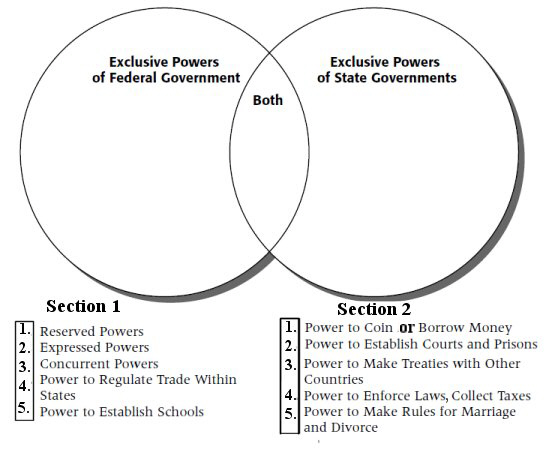
Note: The word “exclusive” means that only that level of
government has a given power. a. | Exclusive Powers of the Federal
Government | b. | Exclusive Powers of the State
Government | c. | Powers held by both levels. | | |
|
|
|
36.
|
Section 1, Question 1
|
|
|
37.
|
Section 1, Question 2
|
|
|
38.
|
Section 1, Question 3
|
|
|
39.
|
Section 1, Question 4
|
|
|
40.
|
Section 1, Question 5
|
|
|
41.
|
Section 2, Question 1
|
|
|
42.
|
Section 2, Question 2
|
|
|
43.
|
Section 2, Question 3
|
|
|
44.
|
Section 2, Question 4
|
|
|
45.
|
Section 2, Question 5
|
Short Answer
|
|
|
46.
|
Extra
Credit: Provide a short answer for each of the following questions. One point per answer is awarded
for a correct answer.
1. Which form or
system of government exists in the United States where power is divided and shared between the
national (or federal) and state level of governments?
2. What is the name of the bicameral legislature that makes the laws
for the state of Virginia?
|