Multiple Choice
Identify the
letter of the choice that best completes the statement or answers the question.
|
|
|
1.
|
Which statement can be said to be true about third parties in American
politics?
a. | They parties rarely win major elections, and have never won a presidential
election. | b. | There have been a number of third party presidents. | c. | The Electoral
College helps get third party candidates elected. | d. | Third parties express broad views help by the
electorate. |
|
|
|
2.
|
The Nineteenth Amendment extended ____ to women.
a. | civil liberties | c. | civil rights | b. | suffrage | d. | equal pay |
|
|
|
3.
|
Which Amendment does not expand the right to vote to include a greater number of
US Citizens?
|
|
|
4.
|
In which civil
liberty are the people in the image above engaging? a. | Right to a speedy trial | c. | Freedom of
Worship | b. | Petition for the Redress of Grievances | d. | Freedom of the
Press |
|
|
|
5.
|
Which Supreme Court case held that segregation on
the basis of race (in public education) was unconstitutional?
a. | Gideon vs.
Wainwright | b. | Dred Scott vs.
Sandford | c. | Brown vs. Board
of Education of Topeka | d. | Miranda vs. Arizona |
|
|
|
6.
|
What is the term for a detailed, written plan of government?
a. | compact | c. | constitution | b. | bicameral | d. | confederation |
|
|
|
7.
|
What part of the Constitution deals with how the legislative branch will
work?
a. | Preamble | c. | Bill of Rights | b. | Article I | d. | the First
Amendment |
|
|
|
8.
|
Which was the first document to guarantee that not even the monarch was above
the law?
a. | Constitution | c. | House of Burgesses | b. | Magna Carta | d. | Mayflower
Compact |
|
|
|
9.
|
How did colonists decided to protest against the Stamp Act, which was repealed
by the British Parliament?
a. | steal weapons | c. | destroy British imports | b. | boycott British
goods | d. | blockade British
ships |
|
|
|
10.
|
Which of the following sections can be found in both the Declaration of
Independence and the Constitution?
a. | Statement of Natural Rights | c. | Crimes of the
King | b. | The Bill of Rights | d. | The Preamble. |
|
|
|
11.
|
What allows people to choose their leaders and voice their opinions on
issues?
a. | rule of law | c. | free elections | b. | majority rule | d. | limited
government |
|
|
|
12.
|
From which important document of American history
does the following quotation come?
III. The said States hereby severally enter into a firm league of friendship
with each other, for their common defense, the security of their liberties, and their mutual and
general welfare
a. | The Articles of Confederation | c. | The Gettysburg
Address | b. | The US Constitution | d. | The English Bill of Rights |
|
|
|
13.
|
What was the legislative body that drew up the English Bill of Rights in
1689?
a. | the First Continental Congress | c. | the House of
Burgesses | b. | Parliament | d. | the Second Continental Congress |
|
|
|
14.
|
E pluribus unum is Latin for
a. | “In God we trust.” | c. | “One nation, under
God.” | b. | “One nation to rule them all.” | d. | “Out of many,
one.” |
|
|
|
15.
|
In the chart above, which branch has the power to declare laws
unconstitutional?
a. | The Congressional branch | c. | The Executive
Branch | b. | The Legislative Branch | d. | The Judicial Branch |
|
|
|
16.
|
How often are elections held for the US House of Representatives and one-third
of the US Senate?
a. | Every year | c. | Every four years | b. | Every two years | d. | every six years |
|
|
|
17.
|
What refers to powers given to state governments but not to the national
government?
a. | separation of powers | c. | expressed powers | b. | reserved powers | d. | checks and
balances |
|
|
|
18.
|
Who led an armed uprising of about 1,200 Massachusetts farmers on a federal
arsenal, an event that led the founding fathers to revise the Articles of Confederation?
a. | Daniel Shays | c. | George Washington | b. | Thomas Paine | d. | John Locke |
|
|
|
19.
|
What term refers to all of the people who are eligible to vote?
a. | tabulates | c. | constituents | b. | masses | d. | electorate |
|
|
|
20.
|
____ are the freedoms to think and act without government interference or fear
of unfair treatment.
a. | Libel | c. | Due process rights | b. | Civil liberties | d. | Censorship |
|
|
|
21.
|
Which proposal called for Congress to have a Senate with equal representation
and a House of Representatives with representation based on population?
a. | Three-Fifths Compromise | c. | New Jersey Plan | b. | Great
Compromise | d. | Olive Branch
Petition |
|
|
|
22.
|
Which types of powers are held by both state and federal governments?
a. | Reserved powers | c. | Enumerated powers | b. | Concurrent powers | d. | Expressed
powers |
|
|
|
23.
|
Public policy is a course of government action to achieve
a. | community goals. | c. | foreign relations. | b. | consumer protection. | d. | national
security. |
|
|
|
24.
|
Unlike citizens, aliens may not
a. | attend public schools. | c. | own property. | b. | hold jobs. | d. | vote in
elections. |
|
|
|
25.
|
According to which principle of democracy, the law applies to everyone, even
those who govern?
a. | First Amendment | c. | rule of law | b. | Bill of Rights | d. | Third Amendment |
|
|
|
26.
|
From which important historical document does the following excerpt
come? Be it enacted by the
General Assembly, That no man shall be compelled to frequent or support any religious worship,
place, or ministry whatsoever, nor shall be enforced, restrained, molested, or burthened in his body
or goods, nor shall otherwise suffer on account of his religious opinions or belief; but that all men
shall be free to profess, and by argument to maintain, their opinion in matters of religion, and that
the same shall in no wise diminish enlarge, or affect their civil
capacities.
a. | The Gettysburg Address | c. | The Virginia Statute of Religious Freedom | b. | The Magna
Carta | d. | The US
Constitution |
|
|
|
27.
|
What is a third party formed only to promote one social, economic, or moral
issue?
a. | lame duck | c. | plank party | b. | stump party | d. | single-issue
party |
|
|
|
28.
|
IN THE NAME OF GOD, AMEN. We, whose names
are underwritten, the Loyal Subjects of our dread Sovereign Lord King James, by the Grace of
God, of Great Britain, France, and Ireland, King, Defender of the Faith,
&c. Having undertaken for the Glory of God, and Advancement of the Christian Faith, and the
Honour of our King and Country, a Voyage to plant the first Colony in the northern Parts of
Virginia;...
IN WITNESS whereof we have hereunto subscribed our names at
Cape-Cod the eleventh of November, in the Reign of our Sovereign Lord King James, of
England, France, and Ireland, the eighteenth, and of Scotland the
fifty-fourth, Anno Domini; 1620.
From which historical
document have the excerpts above been taken?
a. | The Declaration of Independence. | c. | The Magna Carta | b. | The Mayflower
Compact | d. | The Virginia
Charters |
|
|
|
29.
|
In which of the following states did Barack Obama just barely win, but
received all of its electoral votes? (Choices appear below the map and key). 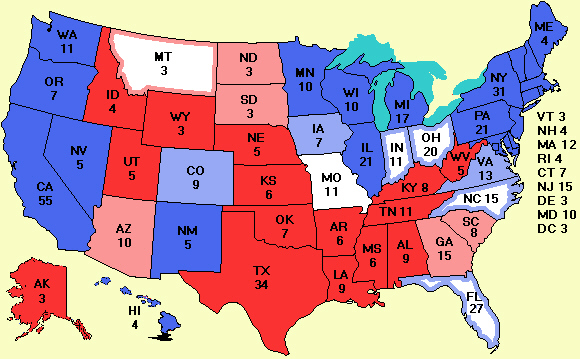 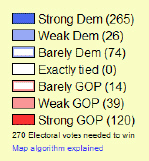 a. | Texas | c. | Florida | b. | Virginia | d. | California |
|
|
|
30.
|
When English judges were asked to try a case, they would look for a a ruling
that had been formed on an earlier case according to common law. What term describes this
idea?
a. | charter. | c. | compact. | b. | precedent. | d. | common law. |
|
|
|
31.
|
Which idea is NOT found in the 14th Amendment to the Constitution?
a. | that all US citizens must receive equal protection of the law. | c. | that citizenship is
defined as anyone born or naturalized in the US is a citzen. | b. | that all men and
women over the age of 18 can vote. | d. | that US citizens must receive due process of law. |
|
|
|
32.
|
Refer to this graphic to answer the question
below: 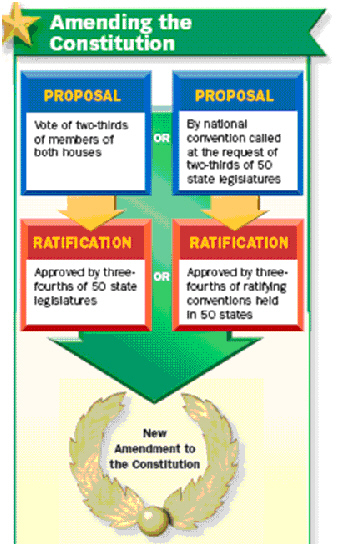 Which legislative group of 3/4 of all the
states must agree to ratify any proposed amendment to the Constitution? a. | The House of Burgesses | c. | Congress | b. | State legislatures | d. | County Councils |
|
|
|
33.
|
A system of law based on precedent and customs is known as
a. | statutory law. | c. | common law. | b. | tort law. | d. | legislature. |
|
|
|
34.
|
The form of government in which power is divided between the national government
and the states is called
a. | federalism. | c. | nationalism. | b. | anti-federalism. | d. | direct
democracy |
|
|
|
35.
|
A ____ is a series of statements expressing a party’s principles, beliefs,
and positions on election issues.
a. | platform | c. | caucus | b. | ward | d. | plank |
|
|
|
36.
|
____ is an attempt to promote a particular person or idea or persuade people to
believe or do something by way of information.
a. | Propaganda | c. | Personification | b. | Incumbency | d. | Canvassing |
|
|
|
37.
|
Special-interest groups help fund a candidate’s campaign by forming which
type of group?
a. | propaganda units. | c. | bankrolls. | b. | political action
committees. | d. | money
beds. |
|
|
|
38.
|
What is the term for people who move permanently to a new country?
a. | immigrants | c. | residents | b. | aliens | d. | citizens |
|
|
|
39.
|
If neither presidential candidate wins a majority of electoral votes, who elects
the president?
a. | Senate | c. | House of Representatives | b. | outgoing
president | d. | Supreme
Court |
|
|
|
40.
|
What provides a way for citizens to approve or reject state or local laws that
have been referred to the people by state legislatures?
a. | referendum | c. | Employment | b. | Impeachment | d. | Recall |
|
|
|
41.
|
What was the name of the peaceful transfer of power that changed the idea of
government in England?
a. | the Glorious Revolution | c. | Shays’s
Rebellion | b. | the Boston Tea Party | d. | the Stamp Act |
|
|
|
42.
|
The Boston Tea Party caused Parliament to pass the Coercive Acts, which
Americans called the
a. | Tea Acts. | c. | Townshend Acts. | b. | Intolerable Acts. | d. | Declaratory
Acts. |
|
|
|
43.
|
The first 10 amendments to the Constitution are known as the
a. | Bill of Rights. | c. | Great Compromise. | b. | Constitutional Convention. | d. | Articles of
Confederation. |
|
|
|
44.
|
OJ Simpson can never be tried again on the murder charge shown below becuase of
which constitutional protection? a. | Just Compensation | c. | No self-incrimination | b. | Eminent
domain | d. | No double
jeopardy |
|
|
|
45.
|
Independent candidates can get on most states’ ballots by
a. | mandate. | c. | plurality. | b. | caucus. | d. | petition. |
|
|
|
46.
|
Government by the consent of the governed is called
a. | public policy. | c. | popular sovereignty. | b. | monarchy | d. | self-perpetuating
autocracy. |
|
|
|
47.
|
As Americans, we show our ____, or love for our country, by flying the
flag.
a. | patriotism | c. | majority rule | b. | jingoism | d. | citizenship |
|
|
|
48.
|
Which term is used to describe the rights given to people accused of a crime in
the United States?
a. | Rights of Liberty | c. | Rights of the Citizen | b. | Citizenship
Rights | d. | Due Process
rights |
|
|
|
49.
|
The ____ defines a U.S. citizen as anyone “born or naturalized in the
United States.”
a. | Fourteenth Amendment | c. | Fifteenth Amendment | b. | Seventeenth Amendment | d. | Sixteenth
Amendment |
|
|
|
50.
|
Use the cartoon below to arrive at the conclusion called for in the
question. What was the final
result of the Great Compromise of 1787, found in the Constitution of the United States? a. | The US Congress was set up as a national bicameral legislature. | c. | The New Jersey plan
was passed. | b. | A one house legislature was set up. | d. | The Virginia Plan set up the
Presidency |
|
|
|
51.
|
A ____ is a court order allowing police to search a suspect’s home or
business and take specific items as evidence.
a. | indictment | c. | grand jury | b. | subpoena | d. | search warrant |
|
|
|
52.
|
The state legislatures that were formed just after the American Revolution had
what characteristic in common with the English Parliament? They were both...
a. | wealthy. | c. | powerless. | b. | unbalanced. | d. | bicameral. |
|
|
|
53.
|
____ is the study of the rights and duties of citizens.
a. | Civics | c. | Citizenship | b. | Patriotism | d. | Economics |
|
|
|
54.
|
Which group was formed by martin Luther King to help bring about civil rights
for blacks and other minorities in the 1950s and 1960s?
a. | The Southern Christian Leadership Confederence (SCLC) | c. | The Nation of
Islam | b. | The NAACP | d. | The Black Panthers |
|
|
|
55.
|
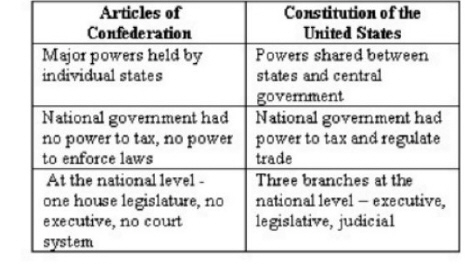 Using the chart above as a guide, which
statement can be considered as true regarding the forms of government of the early American
republic? a. | The Articles of Confederation put in place a strong central government with a
powerful executive. | c. | The Founding Fathers feared a strong central government, but decided to put one in
place after seeing that the Articles were too weak to govern the nation. | b. | The Constitution
gives more power to the states to protect the rights of the people. | d. | In a confederation, the central government
shares power with the states. |
|
|
|
56.
|
A ____ is the ruling authority for a community.
a. | government | c. | majority rule | b. | public policy | d. | democracy |
|
|
|
57.
|
The following section of the Declaration of Independence is taken from which
part of this important American historical document?
We hold
these truths to be self-evident, that all men are created equal, that they are endowed by their
Creator with certain unalienable Rights, that among these are Life, Liberty and the pursuit of
Happiness.--That to secure these rights, Governments are instituted among Men, deriving their just
powers from the consent of the governed...
a. | The Preamble | c. | The list of natural rights of man | b. | The crimes against
the King | d. | The statement of
separation or independence. |
|
|
|
58.
|
Radio, television, and the Internet are considered ____ media.
a. | broadband | c. | invisible | b. | wireless | d. | electronic |
|
|
|
59.
|
The ____ was the first constitution of the United States of America.
a. | Articles of Confederation | c. | United States
Constitution | b. | Declaration of Independence | d. | Mayflower Compact |
|
|
|
60.
|
Which form of government did the American colonies have under Great
Britain?
a. | direct democracy | c. | aristocracy | b. | monarchy | d. | representative
democracy |
|
|
|
61.
|
____ includes the ideas and attitudes that most people hold about the government
and political issues.
a. | Propaganda | c. | Public policy | b. | Mass media | d. | Public opinion |
|
|
|
62.
|
The primary goal of interest groups is to influence
a. | public opinion. | c. | public policy. | b. | the president. | d. | corporations. |
|
|
|
63.
|
Use the graphic above to
answer this question: Advisors to the president and the heads of the executive departments are
called what? a. | Political Parties | c. | The Cabinet | b. | The Courts | d. | Congress |
|
|
|
64.
|
Why was the right to bear arms included in the second amendment?
a. | To allow for a “well-regulated militia” for each
state. | b. | In case the people wanted to rebel against the government. | c. | To help commit
crimes. | d. | So Americans could roll up their sleeves. |
|
|
|
65.
|
Unfair treatment based on prejudice against a certain group is called
what?
a. | discrimination | c. | segregation | b. | racial profiling | d. | affirmative
action |
|
|
|
66.
|
Which First Amendment freedom were the Tinkers exercising when they protested
the Vietnam war by wearing their black arm bands to school? a. | Freedom of Speech | b. | Freedom of the Press | c. | Freedom of
Religion | d. | Freedom to Vote |
|
|
|
67.
|
What is the term for the process by which aliens can become citizens?
a. | probation | c. | naturalization | b. | dual citizenship | d. | immigration |
|
|
|
68.
|
A government controlled by one person or a small group of people is
called
a. | a dictatorship. | c. | a representative democracy. | b. | a direct
democracy. | d. | a parliamentary
government |
|
|
|
69.
|
A ____ party is an association of voters with broad common interests who want to
elect candidates that share those interests.
a. | political | c. | Populist | b. | third | d. | social |
|
|
|
70.
|
Which role do the mass media play regarding how the people relate to their
government in a democracy?
a. | The media set public policy. | b. | The media convince people to donate money to
candidates. | c. | They expose government misconduct. | d. | The media try to get people to oppose
government action. |
|
|
|
71.
|
Which group believed the Constitution should provide protection for certain
basic liberties and opposed its ratification without a bill of rights?
a. | Abolitionists | c. | Anti-Federalists | b. | Liberals | d. | Whigs |
|
|
|
72.
|
The Declaration of Independence states that among our inalienable rights are
“Life, Liberty, and ____.”
a. | freedom of Religion | c. | the pursuit of Happiness | b. | the search for
Prosperity | d. | independence
from Tyranny |
|
|
|
73.
|
In the chart above, which branch has the power to override a presidential
veto?
a. | Executive | c. | The President | b. | Judicial | d. | Legislative |
|
|
|
74.
|
What is the group of people named by each state legislature to select the
president and vice president?
a. | the Electoral College | c. | the House of Representatives | b. | the
Senate | d. | the
Federalists |
|
|
|
75.
|
The middle part of the Constitution’s ____ states the six purposes of the
government.
a. | Preamble | c. | Bill of Rights | b. | amendments | d. | articles |
|
|
|
76.
|
The powers and duties of the which branch include dealing with the leaders of
other countries in order to sign treaties?
a. | judicial branch | c. | industrial branch | b. | legislative branch | d. | executive
branch |
|
|
|
77.
|
What document marked the beginning of self-government in colonial
America?
a. | the House of Burgesses | c. | the First Continental Congress | b. | the Mayflower
Compact | d. | the Boston Tea
Party |
|
|
|
78.
|
What keeps one branch of government from becoming too powerful?
a. | The Elastic Clause | c. | checks and balances | b. | rule of law | d. | supremacy of the
Constitution |
|
|
|
79.
|
Use the image below to answer the question: Which political system best describes
that of the United States? a. | three-party | c. | multiparty | b. | one-party | d. | two-party |
|
|
|
80.
|
The “necessary and proper” clause, also called the
“elastic” clause, allows Congress to exercise which of the following?
a. | judicial powers. | c. | wartime powers. | b. | implied powers. | d. | unconstitutional
powers. |
|
|
|
81.
|
A budget is a plan drawn up by a household or a government for doing which
activity?
a. | helping needy people. | c. | collecting and spending money. | b. | paying
politicians. | d. | protecting
citizens. |
|
|
|
82.
|
How is the number of presidential electors per state determined?
a. | It is determined by the number of voters in each state. | c. | It is set by the
number of members in the House and Senate combined for each state. | b. | Congress must pass a
law that sets the number for each state. | d. | It is equal to the number of members in the House of
Representatives. |
|
|
|
83.
|
Use the follwing chart to answer the questions below: Which two members of the government
sit behind the president when the president addresses a joint session of Congress? a. | President of the Senate and House Majority Leader | c. | Vice president and Speaker of the
House | b. | Speaker of the House and Senate Majority Leader | d. | Secretary of State and Vice
president |
|
|
|
84.
|
Which of the following activities is a civic responsibility?
a. | Registering for the draft | c. | Reading the
newspaper | b. | Paying Taxes | d. | Driving the speed limit. |
|
|
|
85.
|
The ____ is a way that citizens can propose or start new laws or state
constitutional amendments.
a. | electorate | c. | referendum | b. | mandate | d. | initiative |
|
|
|
86.
|
Which of the following amendments allows the federal government to collect
income taxes?
a. | Twenty-seventh | c. | Sixteenth | b. | Fifth | d. | First |
|
|
|
87.
|
Which branch of government is shown here signing a bill into law? a. | Judicial | c. | Executive | b. | Legisexecudicial | d. | Legislative |
|
|
|
88.
|
____ is the first step to gaining American citizenship.
a. | Filing an application for citizenship | c. | The Oath of
Allegiance | b. | Living in the United States for five years | d. | The Declaration of
Intention |
|
|
|
89.
|
More than half the members of the which group voted to break away from Britain
in 1776?
a. | Second Continental Congress | c. | Boston Tea
Party | b. | Committees of Correspondence | d. | Confederation
Congress |
|
|
|
90.
|
____ is the use of violence by groups against civilians to achieve a political
goal.
a. | Terrorism | c. | Police action | b. | Patriotism | d. | Deportation |
|
|
|
91.
|
The right to ____ means the right to ask the government to change something that
is wrong.
a. | eminent domain | c. | petition | b. | slander | d. | libel |
|
All classes: Write a one to two paragraph response to the following
question.
Honors: You must complete question 93 on a separate essay response
sheet.
|
|
|
92.
|
Explain how the Electoral College compromise resolved the argument over how the
president is chosen. Make a case for keeping the Electoral College or for scraping it in favor of
some other system. If you argue in favor of getting rid of the Electoral College, be sure to describe
your suggestions for an alternative method and why your alternative should be adopted.
|
|
|
93.
|
Using the images included here, describe how the legislative branch of American
government is set up. Be sure to outline how each part of the legislative branch came into existence.
Draw a distinction (show the difference) between the three levels of our federal system where the
legislative branch is concerned.
|